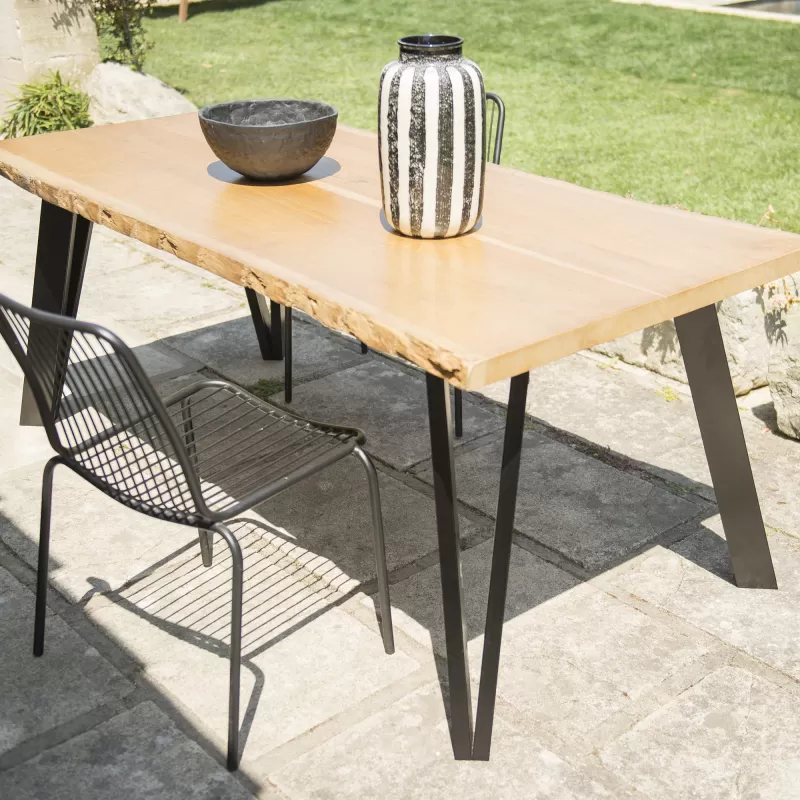
Choosing the number of legs under a table top may seem trivial, but it greatly influences the practicality and comfort of your dining room or dining area. Whether you opt for one center leg, two legs, four legs or a frame, each option has its own advantages and disadvantages. You will see that the choice of feet must be made according to your lifestyle and the number of people in your household. How many table legs to install under a top? How to choose your table legs?
Here you will see all the pros and cons single foot, two feet, four feet or structure, which you will find here at Ripaton, your manufacturer of quality durable furniture. This is what we will explain to you in detail in this article!
1st option: a leg under my table top
The advantages of a central stand
Ideal with a round or oval top, the central foot can be a particularly practical choice. Indeed, if you are used to receiving many guests, You may be uncomfortable with a four-legged table. Indeed, with this type of table, it is not uncommon for one of the guests to have their foot between their knees. The central foot is therefore an excellent idea to overcome the problem!
Installed in the center of a large round table for example, it allows great freedom of movement for everyone. In terms of style, the central foot can fit into a fairly modern or Scandinavian atmosphere for example. With a marble top, you can also give a vintage or art deco touch to your interior.
The inconvenients
The main disadvantage of this type of foot is that he does not allow his legs to be extended under the table. If you install it under a table top to make it a desk, you risk lacking comfort. On the other hand, with some central legs it is not possible to completely store the chairs under the table. It is therefore more suitable for large living rooms, where it also allows you to fill the space well, without giving the impression of emptiness.
2nd option: two feet under my table top
The advantages of two table legs
If you have a large rectangular tray at home, two legs are ideal! They can go very well with a fairly rustic wooden top, to create a large farm table. To do this you can use our feet “ The Crusader "," The Intrepid " or "weThe Gallant ". They have the advantage of taking up very little space. Like the single foot, they are ideal for large tables and entertaining guests.
In short, they are perfect for large families! On the other hand, installing two legs on either side of a tabletop can allow you to create a practical and comfortable office. Concretely, it is a very versatile choice.
The inconvenients
Although it takes up very little space under the table, this type of leg can still have the disadvantage of bothering people at the end of the table. If you are numerous and crowded around the table, diners closest to the feet may have very little room to move their legs. That said, this only happens if there are a lot of people at the table.
3rd option: four legs under my table top
The advantages of four table legs
A table with four legs is the classic choice par excellence. However, this option is far from bland! Indeed, the choice of models is very wide, and exists in many different styles. Do you want to bring a vintage touch to your interior? Opt for hairpin legs ! Do you prefer industrial style? Choose four straight steel legs!
In short, the four legs can be very versatile. They also have the advantage of adapting wonderfully to all shapes of trays, whether round, square, or rectangular. All four feet will fit! Moreover, you can store your chairs under the table without the slightest hindrance. This can be very practical if you are short on space.
The inconvenients
As we saw earlier with the two-legged option, these can be awkward when there are a lot of people at the table. With a small or medium table, without extension, these feet can be problematic for freedom of movement and comfort.
4th option: the table structure
The advantages of the structure
The table structure can be a great option for heavy tops or in delicate materials like glass. In fact, they are more reinforced than the legs alone thanks to their crosspiece. The structures thus make it possible to support very heavy trays. On the other hand, they are ideal as standing tables. In fact, their crossbars allow you to act as a footrest when sitting on a bar chair.
The inconvenients
The disadvantages depend on the number of feet of the structure. You can refer to each disadvantage mentioned above depending on the number of feet of the structure.
Where to put your feet on a table?
As we explained to you in our article “ How to properly position your dining table legs? », the feet must be fixed differently depending on the model chosen and the shape of the top. If you opt for a central leg for example, place it at an equal distance from each edge of the table. With a rectangular tray, you can draw two perpendicular lines under the tray to locate its center.
If you opt for two legs, you can place them flush with the edge of the table. In case the table top is wider than the legs, you must measure an equal distance on each side between the leg and the edge of the table. The four feet, for their part, can be placed between 1 and 15 centimeters from the edge.
To know how many feet to place under your tabletop, it is important to know all the advantages and disadvantages of each option. They can be summarized as follows:
The single foot, or central, is ideal for large tables since it allows you to place a maximum of chairs around the table. On the other hand, it can hinder the storage of chairs under the table.
Both feet are very adaptable and practical. They are perfect for creating a large rectangular farm table style table. On the other hand, they can bother the knees and legs of those seated when there are many of you.
The four feet are a classic but very versatile choice. They adapt to all shapes of tops and come in all different styles. On the other hand, they can be even more annoying than two feet at large tables.
The table structure is particularly suitable for tops made of heavy materials, such as granite for example, since it reinforces the table.
We hope this article has helped you make your choice. If you want to know more about the table structure, check out our article: Why choose a table structure?